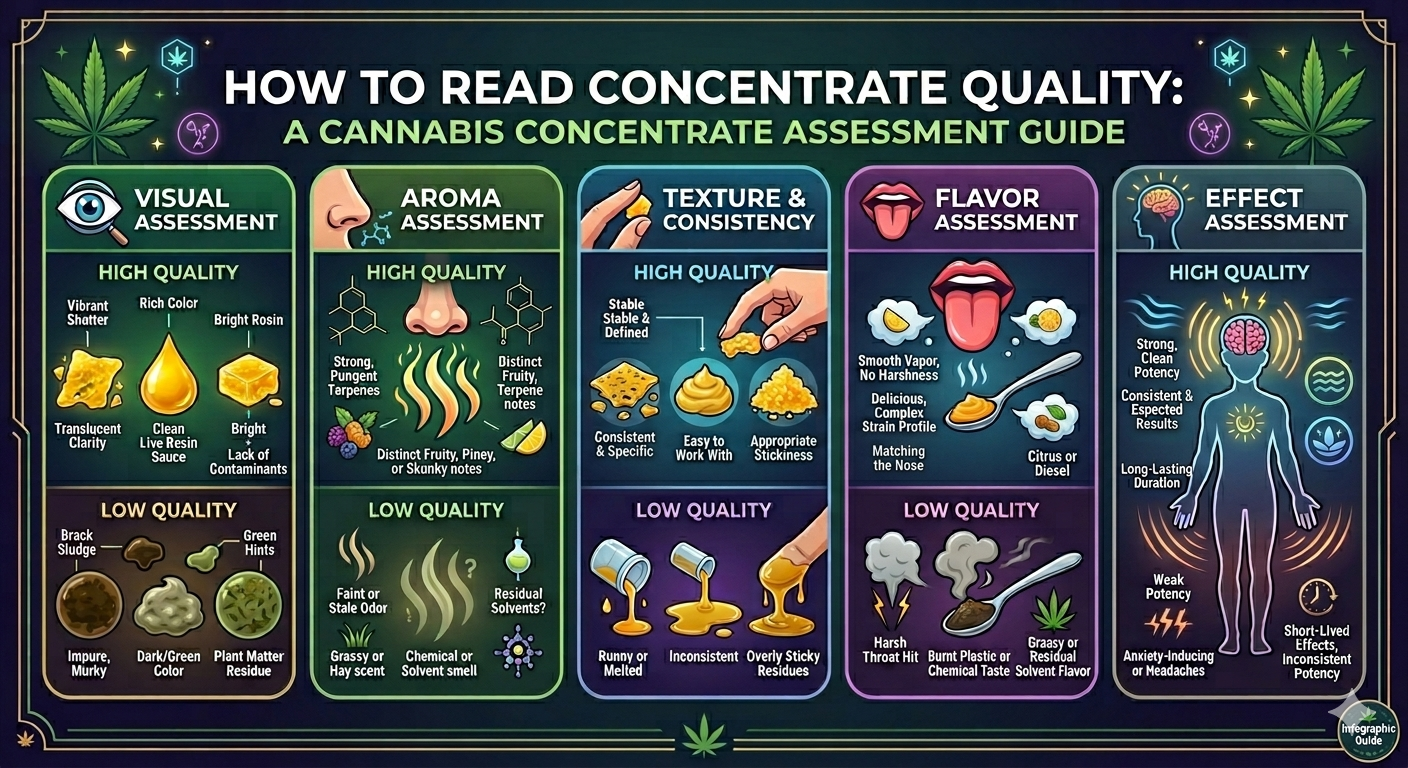
Most cannabis consumers pick concentrates at the dispensary the same way they pick produce — a quick look, maybe a smell if they’re offered it, and a decision based on brand, strain name, or price. A credentialed concentrate professional looks at the same product and reads a different story.
This is how to read that story.
The four assessment pillars
Professional concentrate evaluation — the kind done by Certified Ganjiers and licensed hash judges — assesses four qualities: visual appearance, aroma, texture and consistency, and effect.
1. Visual assessment
Color: Lighter colors generally indicate higher quality in rosin and live resin. Light gold to amber in live rosin suggests minimal heat during processing and high terpene preservation. Very dark colors can indicate overheating, oxidation, or heavy lipid content.
Clarity: Clear or translucent concentrates suggest complete purging of solvents (in solvent-based extracts) and clean processing.
Consistency uniformity: High-quality concentrates are visually consistent — even color, uniform texture, no visible separation or oiling off.
2. Aroma assessment
Intensity: A quality live rosin or live resin opened in a room should make itself known immediately. Weak aroma indicates low terpene content.
Complexity: Quality concentrates smell like something specific — a particular cultivar with distinct terpene notes you can identify. The more specific and complex the aroma, the better the terpene preservation.
Off-notes: Solvent smell (harsh chemical, acetone-like) indicates poor purging. Rancid or fermented notes suggest degradation or contamination.
3. Texture and consistency
Higher terpene content generally means saucier, more fluid consistency. Lower terpene content means harder, more solid consistency. Neither is inherently better — it depends on the cultivar and the intention of the extractor.
Quality concentrates should be consistent with what their category promises. Live rosin from a high-terpene strain should be creamy, saucy, or at minimum pliable. Between your fingers, quality concentrate softens and becomes pliable with warmth.
4. Effect assessment
Onset: Quality concentrates at low temperatures produce a clear, relatively rapid onset — typically within 60–90 seconds.
Flavor alignment: The vapor flavor should align with the aroma you assessed before the dab. If it smelled like citrus and tasted like nothing — the heat was too high and the terpenes were destroyed.
Duration and character: Quality full-spectrum concentrates tend to produce a more complex and sustained effect than more heavily processed products.
Clarity vs. heaviness: What matters is that the effect is clean — not muddled, anxious, or physically uncomfortable. Those are signs of quality issues or a mismatch between the cultivar and your preferences.
Putting it together
The skill of concentrate evaluation is developing the vocabulary and reference points to know what “good” means in each category. This takes time and deliberate attention — tasting concentrates with intention rather than just consuming them.
→ Book a session to develop your concentrate evaluation skills