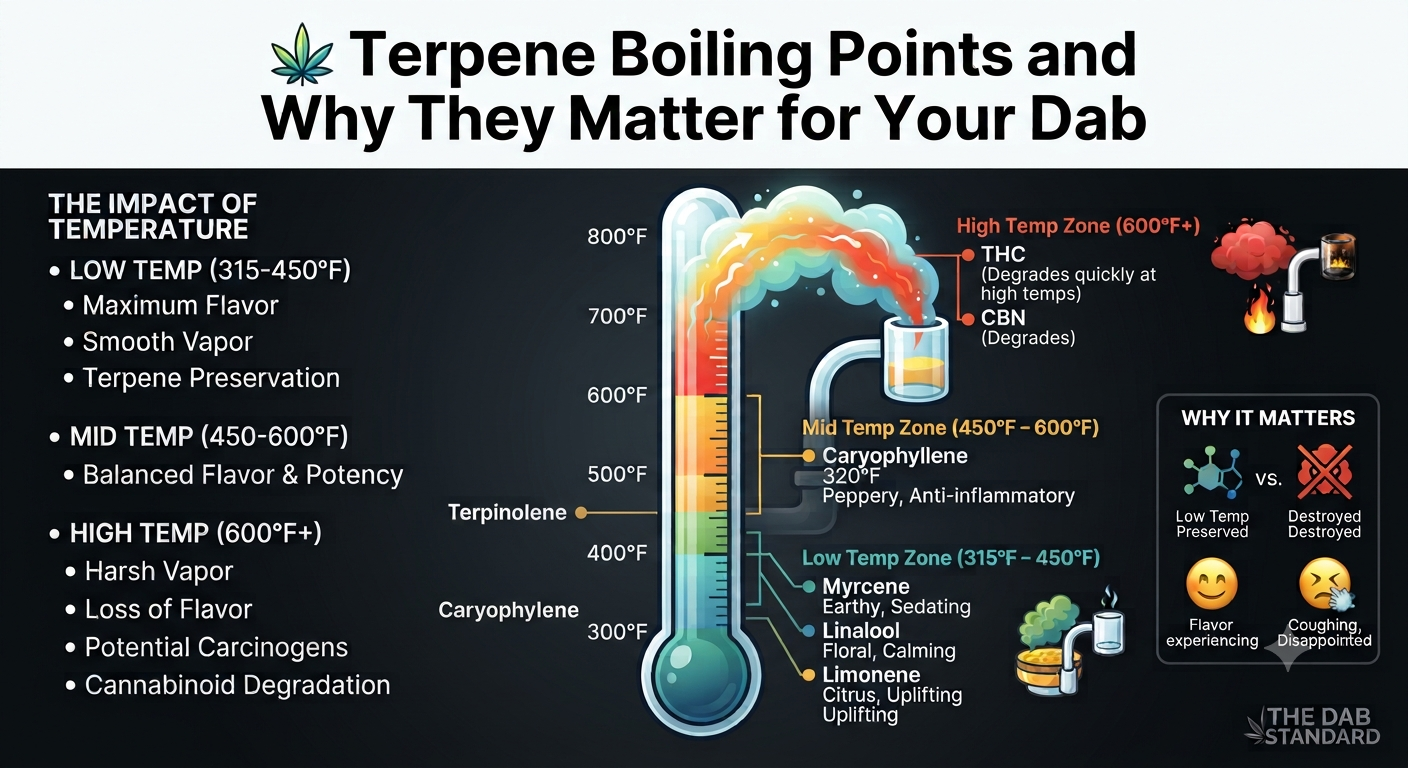
Terpenes are the reason different cannabis concentrates taste different. They’re also, at the dab level, the reason temperature matters as much as it does. Understanding which terpenes vaporize at which temperatures is the foundation of intentional, high-quality dabbing.
What terpenes are
Terpenes are aromatic compounds found in cannabis (and across the plant kingdom) that produce the distinctive smells and flavors of each cultivar. They’re highly volatile — meaning they evaporate relatively easily, especially at elevated temperatures.
In a concentrate, the terpene profile is what makes a Tangie-derived live rosin taste like citrus and an OG Kush rosin taste like earth and pine.
Why they boil at different temperatures
Different terpenes have different molecular weights and vapor pressures, which determines the temperature at which they transition from liquid to vapor. Lighter, more volatile terpenes (like myrcene) evaporate at lower temperatures. Heavier terpenes (like caryophyllene and humulene) require higher temperatures.
This means that the flavor profile of a concentrate is not fixed — it changes with temperature. A dab at 350°F expresses a different subset of the terpene profile than a dab at 450°F.
The terpene reference chart
| Terpene | Common Aroma/Flavor | Boiling Point | Effect Association |
|---|---|---|---|
| Alpha-Pinene | Pine, fresh, earthy | 311°F (155°C) | Alert, memory retention |
| Myrcene | Earthy, musky, tropical fruit | 334°F (168°C) | Relaxing, sedative |
| Limonene | Citrus, lemon, orange | 349°F (176°C) | Uplifting, mood elevation |
| Terpinolene | Fresh, floral, herbal, piney | 366°F (186°C) | Uplifting, slightly sedative |
| Linalool | Floral, lavender, spice | 388°F (198°C) | Calming, anti-anxiety |
| Beta-Caryophyllene | Spicy, pepper, woody | 429°F (221°C) | Anti-inflammatory, relaxing |
| Humulene | Earthy, woody, hoppy | 434°F (223°C) | Appetite suppression |
What this means in practice
At 315°F–350°F: Primarily the most volatile terpenes — alpha-pinene, myrcene, limonene. Bright, light, aromatic flavor. Some users find this range produces thin vapor.
At 350°F–420°F: The sweet spot for most flavor-forward dabbers. The majority of the terpene spectrum is expressing. Cannabinoid delivery is efficient. The most complete picture of a concentrate’s flavor profile.
At 420°F–500°F: Heavier terpenes like caryophyllene and humulene are now expressing, but the lighter terpenes may be exhausted. The flavor shifts — less citrus and floral, more earthy and spicy.
Above 500°F: Most terpenes have been vaporized or destroyed. Minimal terpene expression. Flat or harsh flavor.
How to use this knowledge
Match temperature to terpene dominance. If your concentrate is heavy in limonene (citrus-forward), dabbing at 380°F expresses that terpene fully. If it’s heavy in caryophyllene (spicy), you can go slightly warmer.
Use cold-start for the most volatile terpenes. The cold-start technique never overshoots the temperature range where volatile terpenes express.
Read the aroma as temperature feedback. If your dab tasted flat, you went too hot. If it tasted light and wispy with thin vapor, you went too cool.
Ask about terpene profiles at the dispensary. Some dispensaries and producers publish terpene testing data. If you know the dominant terpenes, you can optimize your temperature for that specific product.
Temperature management isn’t an aesthetic choice — it’s the fundamental control mechanism for what you actually experience from a concentrate. Mastering it is the difference between consuming concentrates and experiencing them.
→ Book a session to learn technique for your specific setup and concentrates